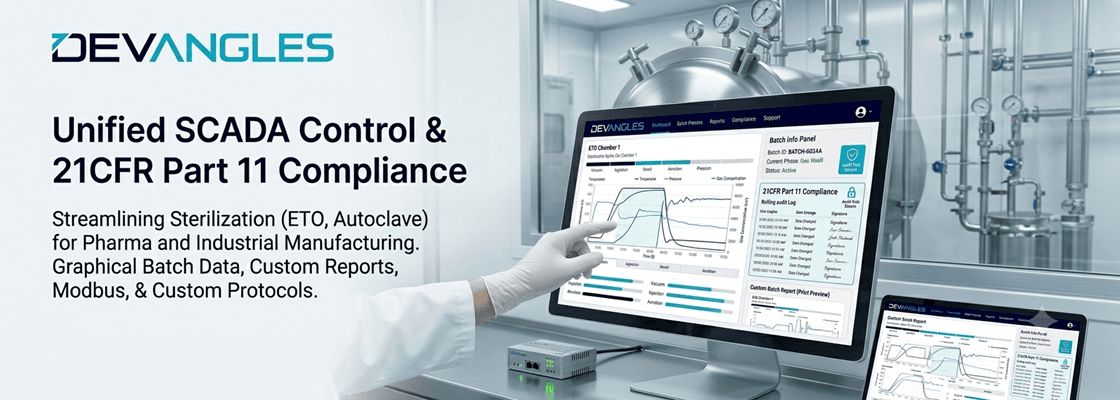
Streamlining Sterilization and Regulatory Compliance with Next-Gen SCADA
A pharmaceutical manufacturer transformed sterilization monitoring, FDA compliance, and batch analytics using an advanced SCADA platform with unified PLC integration and real-time graphical processing.
Executive Summary
A leading pharmaceutical manufacturer faced operational bottlenecks and compliance risks in their sterilization department. Their legacy monitoring systems struggled with disparate PLC protocols, lacked flexible reporting, and failed to meet the stringent electronic record standards required by regulatory bodies.
By deploying our robust SCADA Solution, the manufacturer successfully integrated their Ethylene Oxide (ETO) and Autoclave sterilization lines. The system delivered seamless PLC data acquisition over Modbus and custom protocols, automated 21 CFR Part 11 compliance, and provided real-time graphical batch insights and reduced batch release times by 35%.
The Client & Industry Context
The client is a mid-sized pharmaceutical manufacturer specializing in sterile injectable formulations and medical devices. Sterilization via Autoclave (steam) and ETO (Ethylene Oxide) is a critical, high-stakes phase of their production pipeline. Any deviation in temperature, pressure, or gas concentration can ruin an entire batch, costing hundreds of thousands of dollars and delaying life-saving medications.
The Challenge
The manufacturer’s production floor utilized a mix of legacy and modern PLCs (Programmable Logic Controllers) across different sterilization chambers. This setup created several operational hurdles:
- Protocol Fragmentation: Data was trapped in silos because different machines communicated via Modbus, while others used proprietary, custom protocols.
- Compliance Vulnerabilities: Manual logging and basic data capturing failed to meet the strict FDA 21 CFR Part 11 guidelines for electronic signatures, data integrity, and unalterable audit trails.
- Blind Spots in Batch Processing: Operators could not easily visualize batch cycles in real-time, making it difficult to spot anomalies before a cycle failed.
- Rigid Reporting: Generating compliant batch reports required hours of manual data extraction and spreadsheet manipulation.
The Solution: Advanced SCADA Implementation
The client implemented our SCADA software, specifically designed for high-reliability industrial automation and strict regulatory environments.
1. Unified PLC Data Acquisition
The SCADA system’s flexible driver engine seamlessly connected to the disparate PLCs on the floor. It ingested critical process parameters (temperature, pressure, vacuum levels, and exposure time) over Modbus protocol alongside the client’s legacy custom protocols, unifying all data into a single interface.
2. Built-in 21 CFR Part 11 Compliance
To satisfy FDA requirements, the SCADA platform enforced:
Secure user authentication with role-based access control (RBAC).
Automated, time-stamped Audit Trails capturing every operator action, setpoint change, and alarm acknowledgment.
Cryptographically secure electronic signatures for batch approvals.
3. Batch-Wise Processing Pipeline & Graphical Analytics
The system’s batch management engine allowed operators to initiate, track, and close ETO and Autoclave cycles dynamically.
- Quick-Glance Dashboards: Real-time graphical trends mapped current cycle data against ideal golden batch curves.
- Visual Warnings: Sudden drops in Autoclave pressure or ETO concentration triggered instant visual and audible alarms.
4. Dynamic Custom Reporting
The built-in custom report builder eliminated manual paperwork. Upon batch completion, the system automatically compiled data into a comprehensive Batch Report, featuring:
- Summary metrics (Min/Max/Average values).
- High-resolution charts showing the entire sterilization curve.
- The complete, unalterable audit trail for that specific batch.
The Results & Impact
The deployment of the SCADA solution transformed the manufacturer's sterilization operations from a compliance risk to a competitive advantage.
Batch Report Generation
- Before : 4–6 hours (Manual compilation)
- After : Automated (Instant upon batch closure)
Protocol Compatibility
- Before : Disparate systems / Data silos
- After : 100% Unified (Modbus + Custom Protocols)
Audit Readiness
- Before : High stress, manual logbook reviews
- After : Instant digital audit trail export
Batch Cycle Failures
- Before : 4% annually (Due to late anomaly detection)
- After : < 0.5% (Due to real-time graphical alerts)
"The ability to view a sterilization cycle graphically in real-time, combined with the peace of mind that our data is fully 21 CFR Part 11 compliant, has fundamentally changed how we manage our production pipeline."
— Director of Quality Assurance & Plant Operations
Key Takeaways for General Production Industries
While this insights highlights a pharmaceutical use case, the SCADA product's core architecture offers immense value to any production industry:
- Versatility: The ability to read custom and Modbus protocols makes it an ideal fit for factories with a mix of multi-generational machinery.
- Data-Driven Decisions: Graphical representation of batch data ensures that supervisors, regardless of the industry, can glean actionable insights at a single glance.